Explore All Exams at KGS


All Exams
Explore All Exams at KGS

Khan Sir Courses
Geography I Polity I History | World Map I Indian Map I Economics I Biology

UPSC & State PSC
UPSC I BPSC I UP-PSC I MP-PSC

State Exams
UP I Bihar I MP | Rajasthan

NEET | JEE | CUET
NEET | JEE | CUET

Defence Exams
NDA I CDS I CAPF I AFCAT I SSB I Agniveer

Police Exams
UP SI | Bihar SI | Delhi Police | UP Constable

SSC Exams
CGL I CPO I CHSL I MTS I SSC GD I Delhi Police

Foundation Courses
Physics I Chemistry I Biology I History I Geography I Polity I NCERT I Math I English | Map I Reasoning

Railway Exams
RRB | RPF

Teaching Exams
TET | Teaching | UGC

Banking Exams
SBI | RBI | IBPS

Engineering Exams
Civil | Electrical | Mechanical
UGC NET
UGC NET/JRF
Current Affairs provides you with the best compilation of the Daily Current Affairs taking place across the globe: National, International, Sports, Science and Technology, Banking, Economy, Agreement, Appointments, Ranks, and Report and General Studies
Current Affairs
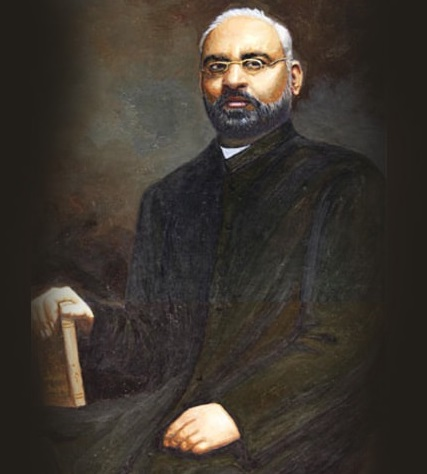
PM Modi Pays Tribute to Shyamji Krishna Varma on His Birth Anniversary
Context: Prime Minister Narendra Modi paid tribute to revolutionary freedom fighter Shyamji Krishna Varma on his birth anniversary on 4 October 2026, recalling his contribution to India’s struggle against British rule.
About Shyamji Krishna Varma
• Born on 4 October 1857 at Mandvi, Kutch, Gujarat, he was a Sanskrit scholar, lawyer and nationalist.
• Influenced by Swami Dayanand Saraswati, he became the first President of the Bombay Arya Samaj.
Contribution to India’s Freedom Struggle
• Indian Home Rule Society (1905): Founded in London to promote Indian self-rule and oppose British colonial rule.
• India House (1905): Established in London to support Indian students; it developed into an important centre of revolutionary nationalism, associated with Vinayak Damodar Savarkar and other revolutionaries.
• The Indian Sociologist (1905): Launched a monthly journal that disseminated nationalist ideas and criticised British rule.
Legacy
• Varma moved to Paris in 1907 and later spent his final years in Geneva, Switzerland, where he died on 30 March 1930.
• His ashes were brought back to India in 2003. Kranti Teerth, a memorial dedicated to him near Mandvi, Gujarat, was inaugurated in 2010.
153rd Assembly of the Inter-Parliamentary Union (IPU)
Context: Deputy Chairman of the Rajya Sabha, Shri Harivansh, is leading the Indian Parliamentary Delegation to the 153rd Assembly of the Inter-Parliamentary Union (IPU), being held in Arusha, Tanzania, from 5–9 October 2026.
More on the News
• Theme: “Enhancing good governance and empowering communities through inclusivity, trust and opportunities for all.”
• Key agenda: The Assembly will discuss inclusive social development, including parliamentary strategies to promote the rights and empowerment of persons with disabilities. The Governing Council will elect a new IPU President, and members will consider a proposed emergency item.
About the Inter-Parliamentary Union (IPU)
• Established in 1889: Founded by parliamentarians William Randal Cremer (United Kingdom) and Frédéric Passy (France), the IPU promotes parliamentary diplomacy, dialogue and peaceful resolution of international disputes.
• Structure and governance:
• Headquarters and membership: Headquartered in Geneva, Switzerland, the IPU currently has 183 Member Parliaments and 15 Associate Members.
• India’s membership: India joined the IPU in 1949 and participated in its conference at Stockholm that year.
• Indian Parliamentary Group (IPG): An autonomous body formed in 1949 following a motion adopted by the Constituent Assembly (Legislative) in 1948.
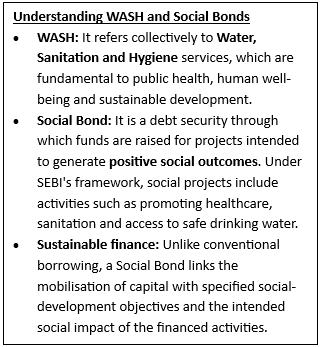
NABKISAN Lists India’s First WASH-Focused Social Bond
Context: NABKISAN Finance Limited, a subsidiary of the National Bank for Agriculture and Rural Development (NABARD), listed India’s first Social Bond dedicated exclusively to the Water, Sanitation and Hygiene (WASH) sector on the National Stock Exchange (NSE) on 1 October 2026, raising ₹180 crore.
More on the News
• Bond details: The five-year bond was oversubscribed 1.8 times, carries a coupon rate of 8.10% and will mature in September 2031. It has been assigned CRISIL AAA (Stable) and CARE AAA (Stable) ratings.
• Use of proceeds: The ₹180 crore raised will be deployed to expand access to safe water, sanitation and hygiene solutions across rural and underserved communities, contributing to improved health, livelihoods and quality of life.
Significance
• Innovative development financing: The issuance demonstrates how capital-market instruments can mobilise resources for critical development priorities and make social infrastructure projects more attractive to investors.
• Rural development: Financing WASH solutions in rural and underserved communities can strengthen health, livelihoods and quality of life, particularly where access to essential services remains inadequate.
• Deepening sustainable finance: The issuance contributes to the development of India's sustainable-finance ecosystem by connecting capital-market funding with clearly defined social outcomes.
Centres of Excellence (CoEs) for Five Classical Languages
Context: The Ministry of Education has approved five Centres of Excellence (CoEs) to strengthen the study, research, preservation and promotion of five recently recognised Classical Languages—Assamese, Bengali, Pali, Marathi and Prakrit.
More on the News
• The five Centres of Excellence will be established at Tezpur University (Assamese), Visva-Bharati University (Bengali), Central University of Odisha (Pali), Central University of Gujarat (Prakrit), and Deccan College Postgraduate and Research Institute, Pune (Marathi).
• The centres will focus on academic research, digitisation, preservation and dissemination of the linguistic and literary heritage of these languages, helping transmit their knowledge traditions to future generations.
About Classical Languages
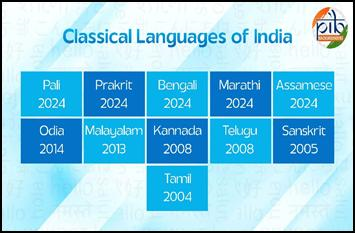
• The Government of India created the Classical Language category in 2004 to recognise languages with a long history, rich ancient literature and significant cultural and intellectual contributions.
• The criteria have subsequently been revised, including in 2005 and 2024, based on recommendations of Linguistic Experts Committees under the Sahitya Akademi.
• In October 2024, Marathi, Pali, Prakrit, Assamese and Bengali were granted Classical Language status, taking the total number of Classical Languages in India to 11.
• The other six are Tamil, Sanskrit, Kannada, Telugu, Malayalam and Odia.
• The revised 2024 criteria include:
Why Classical Language Status Matters
• Preservation of Heritage: Helps preserve ancient texts, manuscripts, inscriptions, literary traditions and knowledge systems for future generations.
• Research and Scholarship: Promotes systematic linguistic, literary, historical and cultural research through dedicated academic institutions.
• Digitisation and Accessibility: Supports the digitisation and documentation of manuscripts and other linguistic resources, making them accessible to researchers and wider audiences.
• Transmission of Knowledge: Facilitates the study and dissemination of India’s ancient intellectual, philosophical and cultural traditions, connecting them with contemporary scholars.
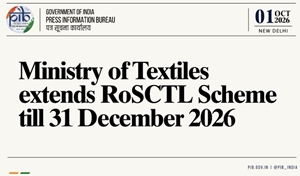
Extension of RoDTEP Scheme up to December 2026
Context: The Department of Commerce extended the Remission of Duties and Taxes on Exported Products (RoDTEP) Scheme up to 31 December 2026.
More on the News
• The scheme was earlier scheduled to expire on 30 September 2026, making this a three-month extension.
• The extension covers exports by Domestic Tariff Area (DTA) units, Advance Authorisation (AA) holders, Special Economic Zone (SEZ) units and Export Oriented Units (EOUs).
• The existing RoDTEP rates and value caps under Appendix 4R and Appendix 4RE, applicable on 30 September 2026, will continue unchanged.
• Other terms and conditions governing the scheme will also remain unchanged during the extended period.
About the Remission of Duties and Taxes on Exported Products (RoDTEP)
• Launched: 1 January 2021.
• Objective: To remit un-rebated Central, State and local duties, taxes and levies embedded in exported products, including prior-stage cumulative indirect taxes.
• It addresses taxes and levies that are not refunded or rebated through other mechanisms, ensuring that domestic taxes do not remain embedded in export prices.
• The benefit is generally provided as a notified percentage of export value, subject to product-specific value caps; for some products, a fixed amount per unit may apply.
• Current notified rebates can range from 0.3% to 3.9%, depending on the product.
• Benefits are issued through transferable electronic duty credit scrips (e-scrips) maintained through the ICEGATE platform.
• These e-scrips can be used for payment of Basic Customs Duty and can also be transferred.
• The scheme operates within an annual budgetary framework, with rates and benefits subject to periodic review.
• It seeks to provide a level playing field for Indian exporters in international markets by improving export price competitiveness.
ASEAN-India Maritime Exercise (AIME-2026)
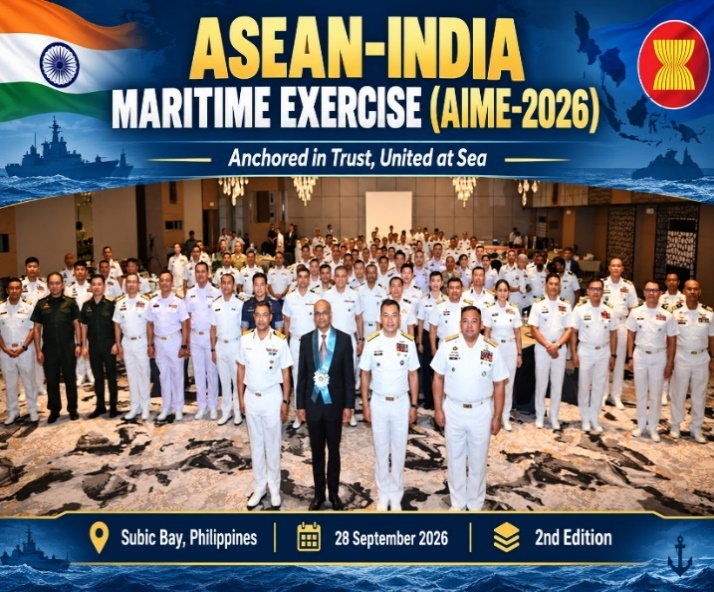
Context: The second edition of the ASEAN-India Maritime Exercise (AIME-2026) commenced at Subic Bay, Philippines, on 28 September 2026, bringing together India and ASEAN maritime forces.
About the ASEAN-India Maritime Exercise 2026
• AIME-2026 is the second edition of the ASEAN-India Maritime Exercise, conducted under the theme “Anchored in Trust, United at Sea.”
• First edition: AIME-2023 was held in Singapore in May 2023.
• The exercise is co-hosted by the Indian Navy and the Philippine Navy and involves INS Sahyadri and INS Kulish along with maritime forces from ASEAN Member States.
• It is conducted in two phases:
• The exercise supports India’s Act East Policy and the MAHASAGAR vision — Mutual and Holistic Advancement for Security and Growth Across Regions.
Significance
• Strengthens maritime cooperation: Enhances mutual understanding and practical cooperation between India and ASEAN maritime forces.
• Improves interoperability: Joint training and coordinated activities strengthen the ability of participating forces to operate together effectively.
• Promotes maritime security: Cooperation in areas such as maritime domain awareness and coordinated sea operations contributes to a secure maritime environment.
• Advances regional partnerships: Reinforces India’s strategic engagement with ASEAN and its wider Indo-Pacific maritime outreach.
Khan Global Studies App
With our training programs, learning online can be a very exciting experience. Take the next step toward achieving your professional and personal objectives.


Course Related Query:
Ask Your DoubtsStore Related Query:[email protected]NEET | JEE | CUET
NCERT Books
Resources
We love learning. Through our innovative solutions, we encourage ourselves, our teams, and our Students to grow. We welcome and look for diverse perspectives and opinions because they enhance our decisions. We strive to understand the big picture and how we contribute to the company’s objectives. We approach challenges with optimism and harness the power of teamwork to accomplish our goals. These aren’t just pretty words to post on the office wall. This is who we are. It’s how we work. And it’s how we approach every interaction with each other and our Students.
Come with an open mind, hungry to learn, and you’ll experience unmatched personal and professional growth, a world of different backgrounds and perspectives, and the freedom to be you—every day. We strive to build and sustain diverse teams and foster a culture of belonging. Creating an inclusive environment where every students feels welcome, appreciated, and heard gives us something to feel (really) good about.