Explore All Exams at KGS


All Exams
Explore All Exams at KGS

Khan Sir Courses
Geography I Polity I History | World Map I Indian Map I Economics I Biology

UPSC & State PSC
UPSC I BPSC I UP-PSC I MP-PSC

State Exams
UP I Bihar I MP | Rajasthan

NEET | JEE | CUET
NEET | JEE | CUET

Defence Exams
NDA I CDS I CAPF I AFCAT I SSB I Agniveer

Police Exams
UP SI | Bihar SI | Delhi Police | UP Constable

SSC Exams
CGL I CPO I CHSL I MTS I SSC GD I Delhi Police

Foundation Courses
Physics I Chemistry I Biology I History I Geography I Polity I NCERT I Math I English | Map I Reasoning

Railway Exams
RRB | RPF

Teaching Exams
TET | Teaching | UGC

Banking Exams
SBI | RBI | IBPS

Engineering Exams
Civil | Electrical | Mechanical
UGC NET
UGC NET/JRF
Current Affairs provides you with the best compilation of the Daily Current Affairs taking place across the globe: National, International, Sports, Science and Technology, Banking, Economy, Agreement, Appointments, Ranks, and Report and General Studies

Current Affairs
SYLLABUS
GS-3: Conservation, Environmental Pollution and Degradation; Science and Technology- Developments and their Applications and Effects in Everyday Life.
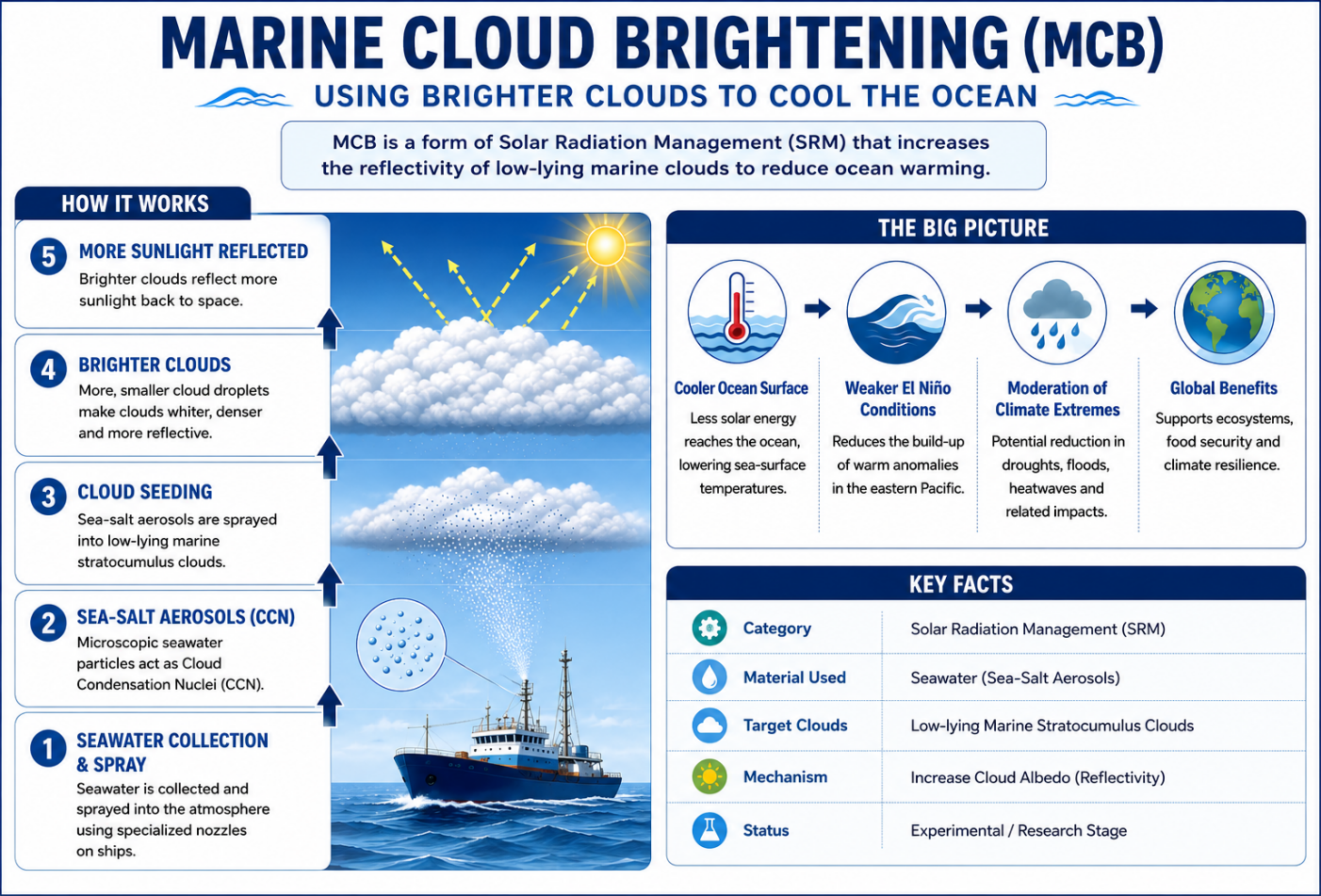
Context: A recent study published in Science Advances has suggested that Marine Cloud Brightening (MCB)—a technique involving the spraying of seawater particles into marine clouds—could potentially weaken or prevent the development of a super El Niño, thereby reducing its global climatic impacts.
Key Findings of the Study
• The study found that Marine Cloud Brightening (MCB) over the southeastern Pacific could potentially weaken or prevent a super El Niño by cooling ocean waters and disrupting the ocean-atmosphere feedbacks that drive its growth.
• Simulations of the 1997–98 and 2015–16 El Niño events showed that early and sustained interventions were most effective, with the potential to restore neutral ENSO conditions or even induce La Niña-like cooling.
• Researchers drew insights from the 2019–20 Australian bushfires, where aerosol-induced cloud brightening over the Pacific was followed by an unusual multi-year La Niña phase, indicating the influence of cloud reflectivity on climate patterns.
• The simulations suggest that MCB could reverse several temperature and rainfall anomalies linked to extreme El Niño events, helping reduce droughts, floods, heatwaves, and associated economic losses.
• The findings highlight the potential of targeted geoengineering to manage seasonal climate variability such as ENSO, although the technique remains experimental and untested at scale.
Understanding the Science: El Niño and Marine Cloud Brightening (MCB)
• El Niño
• Marine Cloud Brightening (MCB)
Potential Significance of the Study
• Reducing Extreme Weather Risks: If proven effective, MCB could help moderate droughts, floods, heatwaves, and other weather extremes often associated with super El Niño events, thereby reducing humanitarian and economic losses.
• Protecting Marine Ecosystems: By lowering sea-surface temperatures, MCB may help reduce marine heatwaves and coral bleaching events that threaten biodiversity-rich marine ecosystems.
• Economic and Food Security Benefits: Since super El Niño events can trigger major agricultural losses, fisheries disruptions, and water stress, moderating their intensity could improve food security and reduce economic losses in climate-vulnerable regions.
• Implications for the Indian Monsoon: Since strong El Niño episodes are frequently linked with weaker monsoon rainfall in India, limiting their intensity could potentially reduce rainfall variability and support agricultural stability.
Concerns and Limitations
• Dependence on Model Simulations: The findings are based primarily on climate models and have not been validated through large-scale field experiments. Actual climatic responses may differ from simulated outcomes.
• Risk of Unintended Climatic Effects: Deliberately altering cloud properties could influence rainfall patterns, atmospheric circulation, or ocean conditions in unforeseen ways, potentially shifting climate risks from one region to another.
• Operational and Technological Challenges: Large-scale deployment would require specialised systems capable of dispersing seawater aerosols over vast oceanic areas, a capability that remains technologically challenging and largely untested.
• Governance and Ethical Challenges: Geoengineering interventions may have transboundary consequences, raising complex questions regarding international regulation, liability, decision-making authority, and equitable distribution of risks and benefits.
• Not a Replacement for Climate Mitigation: MCB may help manage certain climatic impacts, but it does not address the underlying drivers of climate change, particularly rising greenhouse-gas emissions.
Khan Global Studies App
With our training programs, learning online can be a very exciting experience. Take the next step toward achieving your professional and personal objectives.



Course Related Query:
Ask Your DoubtsStore Related Query:[email protected]NEET | JEE | CUET
NCERT Books
Resources
We love learning. Through our innovative solutions, we encourage ourselves, our teams, and our Students to grow. We welcome and look for diverse perspectives and opinions because they enhance our decisions. We strive to understand the big picture and how we contribute to the company’s objectives. We approach challenges with optimism and harness the power of teamwork to accomplish our goals. These aren’t just pretty words to post on the office wall. This is who we are. It’s how we work. And it’s how we approach every interaction with each other and our Students.
Come with an open mind, hungry to learn, and you’ll experience unmatched personal and professional growth, a world of different backgrounds and perspectives, and the freedom to be you—every day. We strive to build and sustain diverse teams and foster a culture of belonging. Creating an inclusive environment where every students feels welcome, appreciated, and heard gives us something to feel (really) good about.