Explore All Exams at KGS


All Exams
Explore All Exams at KGS

Khan Sir Courses
Geography I Polity I History | World Map I Indian Map I Economics I Biology

UPSC & State PSC
UPSC I BPSC I UP-PSC I MP-PSC

State Exams
UP I Bihar I MP | Rajasthan

NEET | JEE | CUET
NEET | JEE | CUET

Defence Exams
NDA I CDS I CAPF I AFCAT I SSB I Agniveer

Police Exams
UP SI | Bihar SI | Delhi Police | UP Constable

SSC Exams
CGL I CPO I CHSL I MTS I SSC GD I Delhi Police

Foundation Courses
Physics I Chemistry I Biology I History I Geography I Polity I NCERT I Math I English | Map I Reasoning

Railway Exams
RRB | RPF

Teaching Exams
TET | Teaching | UGC

Banking Exams
SBI | RBI | IBPS

Engineering Exams
Civil | Electrical | Mechanical
UGC NET
UGC NET/JRF
Current Affairs provides you with the best compilation of the Daily Current Affairs taking place across the globe: National, International, Sports, Science and Technology, Banking, Economy, Agreement, Appointments, Ranks, and Report and General Studies
Current Affairs
SYLLABUS
GS-1: Population and associated issues, poverty and developmental issues, urbanization, their problems and their remedies.
GS-2: Government Policies and Interventions for Development in various sectors and Issues arising out of their Design and Implementation.
Context: Ladakh, one of India’s two youngest Union Territories, will become the first place in independent India to enumerate caste as part of a regular Census when the Population Enumeration phase of Census 2027 begins there in August 2026.
More on the News
• Ladakh will begin Population Enumeration ahead of the rest of India because it is a snow-bound region where enumeration during the usual February 2027 window would be difficult due to winter and inaccessible terrain.
• The self-enumeration window will open from August 17–31, 2026, followed by house-to-house Population Enumeration from September 1–30, 2026, with a revisional round from October 1–5, 2026.
• The exercise will also cover snow-bound areas of Jammu and Kashmir, Himachal Pradesh and Uttarakhand, while the rest of the country will conduct Population Enumeration in February 2027.
• Ladakh will also use paper schedules in addition to digital enumeration because defence establishments along the borders with China and Pakistan cannot be geo-tagged due to security concerns.
• Ladakh was not among the 16 States and Union Territories where the Population Enumeration questionnaire was pre-tested from July 1–20, 2026.
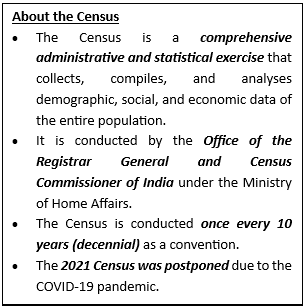
About the Census of India 2027
• Census 2027 will be the 16th Census of India and the 8th after Independence, conducted under the Census Act, 1948 and Census Rules, 1990.
• Census 2027 will be conducted in two phases:
• March 1, 2027 is the reference date for most of the country, while October 1, 2026 is the reference date for snow-bound regions.
• Census 2027 is India’s first digital Census, using mobile applications for real-time data collection, a Census Management & Monitoring System (CMMS), the Houselisting Block Creator Web Map Application, self-enumeration and data-security features.
• Census-as-a-Service (CaaS) will facilitate clean, machine-readable and actionable data delivery to Ministries, along with dashboards and visualisation tools down to the village and ward level.
• The likely methodology is an open-ended caste column, under which respondents will state their caste and enumerators will record it as declared.
Historical Overview of Census in India
Pre-Independence:
• The first census exercises were conducted in Allahabad in 1824 and Banaras in 1827–28 by James Prinsep, while the first complete census of an Indian city was conducted in Dacca in 1830 by Henry Walter.
• The first nationwide census was undertaken in 1872 under Lord Mayo.
• The first modern synchronous census covering British India, except Kashmir, was conducted in 1881 under W.C. Plowden, establishing the decennial Census tradition.
• The 1931 Census was the last published comprehensive caste census before Independence and recorded 4,147 castes.
• The 1941 Census also collected caste details, but its processing and publication were disrupted by the Second World War.
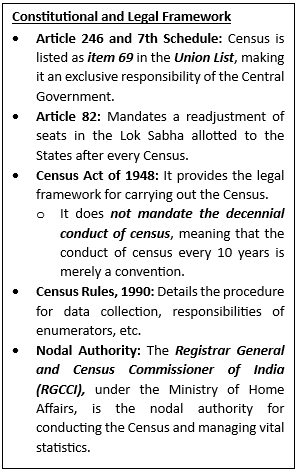
Post-Independence:
• The 1951 Census was the first Census conducted under the Census Act, 1948. After Independence, caste enumeration for the general population was discontinued, while Scheduled Castes and Scheduled Tribes continued to be enumerated.
• The National Population Register (NPR) was launched in 2010 and updated in 2015.
• The SECC 2011 was conducted separately from the regular Census and was outside the purview of the Census Act, 1948. It collected caste information through an open-ended response, generating over 46 lakh caste names.
• In 2015, the government constituted an expert group headed by Arvind Panagariya, then Vice-Chairman of NITI Aayog, to examine and classify the caste data; however, the caste component was never released.
• Census 2027 marks a major departure by incorporating caste enumeration into the regular statutory Census.
Khan Global Studies App
With our training programs, learning online can be a very exciting experience. Take the next step toward achieving your professional and personal objectives.



Course Related Query:
Ask Your DoubtsStore Related Query:[email protected]NEET | JEE | CUET
NCERT Books
Resources
We love learning. Through our innovative solutions, we encourage ourselves, our teams, and our Students to grow. We welcome and look for diverse perspectives and opinions because they enhance our decisions. We strive to understand the big picture and how we contribute to the company’s objectives. We approach challenges with optimism and harness the power of teamwork to accomplish our goals. These aren’t just pretty words to post on the office wall. This is who we are. It’s how we work. And it’s how we approach every interaction with each other and our Students.
Come with an open mind, hungry to learn, and you’ll experience unmatched personal and professional growth, a world of different backgrounds and perspectives, and the freedom to be you—every day. We strive to build and sustain diverse teams and foster a culture of belonging. Creating an inclusive environment where every students feels welcome, appreciated, and heard gives us something to feel (really) good about.