Explore All Exams at KGS


All Exams
Explore All Exams at KGS

Khan Sir Courses
Geography I Polity I History | World Map I Indian Map I Economics I Biology

UPSC & State PSC
UPSC I BPSC I UP-PSC I MP-PSC

Judiciary
CLAT

State Exams
UP I Bihar I MP | Rajasthan

NEET | JEE | CUET
NEET | JEE | CUET

Defence Exams
NDA I CDS I CAPF I AFCAT I SSB I Agniveer

Police Exams
UP SI | Bihar SI | Delhi Police | UP Constable

SSC Exams
CGL I CPO I CHSL I MTS I SSC GD I Delhi Police

Foundation Courses
Physics I Chemistry I Biology I History I Geography I Polity I NCERT I Math I English | Map I Reasoning

Railway Exams
RRB | RPF

Teaching Exams
TET | Teaching | UGC

Banking Exams
SBI | RBI | IBPS

Engineering Exams
Civil | Electrical | Mechanical
UGC NET
UGC NET/JRF
Current Affairs provides you with the best compilation of the Daily Current Affairs taking place across the globe: National, International, Sports, Science and Technology, Banking, Economy, Agreement, Appointments, Ranks, and Report and General Studies
Current Affairs
SYLLABUS
GS-2: Welfare schemes for vulnerable sections of the population by the Centre and States. Issues relating to development and management of Social Sector/Services relating to Health, Education, Human Resources.
Context: The Keralam Legislative Assembly unanimously passed the Keralam Senior Citizens’ (Care and Protection of Rights) Bill, 2026, making Keralam the first state in India to pass comprehensive legislation specifically focused on the care, protection and rights of senior citizens.
Key Provisions of the Bill
• Protection of Rights: Safeguards dignity, independence and protection against abuse, neglect, exploitation and abandonment.
• Regulation of Care Centres: Provides for registration and regulation of old-age homes, care centres and home-based care services.
• Caregiver Development: Promotes caregiver training, certification and capacity-building of family members.
• Institutional Mechanism: Proposes senior citizens' desks in local bodies, police nodal officers and dedicated state- and district-level protection units.
• Penal Provisions: Provides imprisonment up to three years and a fine up to ₹50,000 for specified offences, including cruelty, mental harassment and abandonment.
• Ageing at Home: Promotes home-based care, accessible public spaces, legal assistance, digital inclusion and assistive products.
• Living Wills: Recognises advance medical directives in accordance with Supreme Court guidelines.
• Financial and Economic Support: Proposes a State Reserve Fund and encourages entrepreneurship, mentoring and income-generating opportunities for senior citizens.
Need and Significance of the Bill
• Rights-Based Approach: Moves beyond conventional welfare towards dignity, autonomy and protection against exploitation.
• Better Care Infrastructure: Regulation of care centres and trained caregivers can improve the quality and affordability of elderly care.
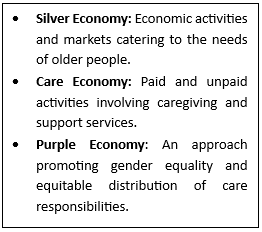
• Gender Equality: Formal care services can reduce the disproportionate burden of unpaid caregiving on women.
• Productive Ageing: Enables senior citizens to contribute through mentoring, entrepreneurship and community development.
• Silver Economy: Creates opportunities in healthcare, assisted living, rehabilitation and assistive technologies while generating employment.
India's Ageing Population and Demographic Transition
• Growing Elderly Population: India's population aged 60 and above is projected to increase from 100 million in 2011 to 230 million by 2036 (14.9% of the population).
• Global Trend: WHO projects that the global population aged 60 and above will increase from 1.1 billion in 2023 to 1.4 billion by 2030.
• Kerala's Ageing: Elderly people constituted around 15% of Kerala's population in 2021, projected to reach 30% by 2051.
• Workforce Decline: Kerala's working-age population share is projected to decline from approximately 63% to 59.5% over the next decade, according to an RBI report.
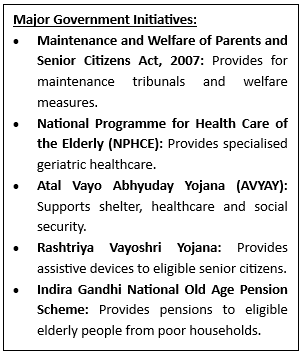
Emerging Challenges of an Ageing Society
• Economic and Healthcare Burden: Rising pension, healthcare and long-term care expenditure, alongside a shrinking workforce, may strain public finances. Dementia and non-communicable diseases further increase healthcare needs.
• Social Isolation and Abuse: Migration, declining joint-family structures and digital exclusion increase loneliness, abandonment and financial exploitation.
• Gendered Caregiving: According to the Time Use Survey 2024, women spend 140 minutes daily on unpaid caregiving compared with 74 minutes for men.
• Unequal Care Infrastructure: Shortages of trained caregivers, geriatric specialists and affordable facilities disproportionately affect poor and rural elderly people.
Way Forward
• Strengthen Care Economy: Expand affordable home healthcare, rehabilitation, assisted living and community-based care through public investment.
• Promote Purple Economy: Ensure equitable distribution of caregiving responsibilities through state-supported infrastructure, fair wages and social security for caregivers.
• Develop Silver Economy: Encourage startups, assistive technologies, accessible housing and opportunities for senior citizens in mentoring and entrepreneurship.
• Strengthen Local Governance: Introduce dedicated senior citizens' sub-plans for panchayats and municipalities, improve pension coverage and establish monitoring mechanisms.
Khan Global Studies App
With our training programs, learning online can be a very exciting experience. Take the next step toward achieving your professional and personal objectives.



Course Related Query:
Ask Your DoubtsStore Related Query:[email protected]NEET | JEE | CUET
NCERT Books
Resources
We love learning. Through our innovative solutions, we encourage ourselves, our teams, and our Students to grow. We welcome and look for diverse perspectives and opinions because they enhance our decisions. We strive to understand the big picture and how we contribute to the company’s objectives. We approach challenges with optimism and harness the power of teamwork to accomplish our goals. These aren’t just pretty words to post on the office wall. This is who we are. It’s how we work. And it’s how we approach every interaction with each other and our Students.
Come with an open mind, hungry to learn, and you’ll experience unmatched personal and professional growth, a world of different backgrounds and perspectives, and the freedom to be you—every day. We strive to build and sustain diverse teams and foster a culture of belonging. Creating an inclusive environment where every students feels welcome, appreciated, and heard gives us something to feel (really) good about.