Explore All Exams at KGS


All Exams
Explore All Exams at KGS

Khan Sir Courses
Geography I Polity I History | World Map I Indian Map I Economics I Biology

UPSC & State PSC
UPSC I BPSC I UP-PSC I MP-PSC

Judiciary
CLAT

State Exams
UP I Bihar I MP | Rajasthan

NEET | JEE | CUET
NEET | JEE | CUET

Defence Exams
NDA I CDS I CAPF I AFCAT I SSB I Agniveer

Police Exams
UP SI | Bihar SI | Delhi Police | UP Constable

SSC Exams
CGL I CPO I CHSL I MTS I SSC GD I Delhi Police

Foundation Courses
Physics I Chemistry I Biology I History I Geography I Polity I NCERT I Math I English | Map I Reasoning

Railway Exams
RRB | RPF

Teaching Exams
TET | Teaching | UGC

Banking Exams
SBI | RBI | IBPS

Engineering Exams
Civil | Electrical | Mechanical
UGC NET
UGC NET/JRF
Current Affairs provides you with the best compilation of the Daily Current Affairs taking place across the globe: National, International, Sports, Science and Technology, Banking, Economy, Agreement, Appointments, Ranks, and Report and General Studies
Current Affairs
SYLLABUS
GS-3: Science and Technology – Developments and their Applications and Effects in Everyday Life; Achievements of Indians in Science and Technology; Indigenisation of Technology.
Context: The Ministry of Electronics and Information Technology (MeitY), under the IndiaAI Mission, released three indigenous foundation models—EKA-1, Dhīr 2B and Dhīr 5B—to strengthen India's domestic AI capabilities and technological autonomy.
More on the News
• EKA-1 (Soket Labs): An open, sparse hybrid model with 26.3 billion parameters, trained on about 7.5 trillion tokens.
• Dhīr 2B and Dhīr 5B (ZenteiQ): These open-source models, with 2 billion and 5 billion parameters respectively, support English and 10 Indian languages and enable document-grounded automation, knowledge retrieval and multilingual services.
About the IndiaAI Mission
• Launch and outlay: Approved by the Union Cabinet in March 2024, with ₹10,371.92 crore over five years.
• Vision: "Making AI in India and Making AI Work for India."
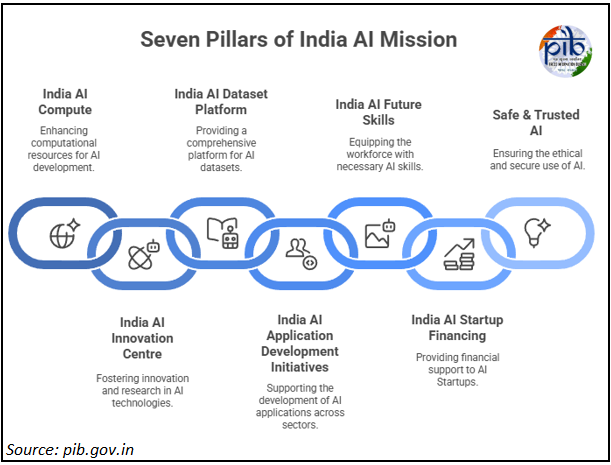
• Implementation: Implemented by IndiaAI, an independent business division under MeitY, the Mission builds an AI ecosystem through computing infrastructure, datasets, indigenous models, skills, startup support and responsible AI.
• Progress: More than 45,000 GPUs were onboarded by June 2026.
About Indigenous AI Foundation Models
• Foundation Models are large-scale AI systems trained on extensive datasets and adaptable to multiple tasks.
• Large Language Models (LLMs) specialise in understanding and generating language, while multimodal models process combinations of text, speech and images.
• IndiaAI Innovation Centre (Foundation Models) Pillar
• Other Indigenous AI Models
Significance of Indigenous AI Foundation Models
• Strategic Autonomy: Reduces dependence on foreign AI systems and strengthens India's ability to develop and deploy models aligned with national priorities.
• Linguistic Inclusion: Indian-language models make AI services more accessible to non-English speakers and help bridge the digital divide.
• Privacy and Cybersecurity: On-device, on-premise and air-gapped deployment can keep sensitive data within devices or organisational systems, reducing exposure to external cloud networks.
• India-specific Solutions: Models trained on Indian data and contexts can address requirements in banking, cybersecurity, defence, governance, healthcare, education and industry.
• Innovation and Productivity: Shared computing, public funding and access to open models lower entry barriers for startups and researchers, encourage domestic innovation and improve efficiency across public and private services.
Khan Global Studies App
With our training programs, learning online can be a very exciting experience. Take the next step toward achieving your professional and personal objectives.


Course Related Query:
Ask Your DoubtsStore Related Query:[email protected]NEET | JEE | CUET
NCERT Books
Resources
We love learning. Through our innovative solutions, we encourage ourselves, our teams, and our Students to grow. We welcome and look for diverse perspectives and opinions because they enhance our decisions. We strive to understand the big picture and how we contribute to the company’s objectives. We approach challenges with optimism and harness the power of teamwork to accomplish our goals. These aren’t just pretty words to post on the office wall. This is who we are. It’s how we work. And it’s how we approach every interaction with each other and our Students.
Come with an open mind, hungry to learn, and you’ll experience unmatched personal and professional growth, a world of different backgrounds and perspectives, and the freedom to be you—every day. We strive to build and sustain diverse teams and foster a culture of belonging. Creating an inclusive environment where every students feels welcome, appreciated, and heard gives us something to feel (really) good about.