KGS

All Exams

Explore All Exams at KGS

All Exams
Home>Current Affairs>India–Australia Civil Nuclear Cooperation
Current Affairs made simple.

Current Affairs provides you with the best compilation of the Daily Current Affairs taking place across the globe: National, International, Sports, Science and Technology, Banking, Economy, Agreement, Appointments, Ranks, and Report and General Studies

banner-image

Current Affairs

India–Australia Civil Nuclear Cooperation

SYLLABUS

GS-3: Infrastructure- Energy; Science and Technology- developments and their applications and effects in everyday life; Indigenization of technology and developing new technology.

Context: India and Australia have finalised the Administrative Arrangement under the India–Australia Civil Nuclear Cooperation Agreement during the Third India–Australia Annual Summit held in Melbourne.

About India–Australia Civil Nuclear Cooperation

  • India and Australia signed the Civil Nuclear Cooperation Agreement in September 2014, which entered into force in November 2015.
  • The Agreement provides the framework for civil nuclear cooperation and enables Australian companies to export uranium to India on a commercial basis.
  • Key Features:
    • Enables long-term exports of Australian uranium to India.
    • Uranium will be used exclusively for peaceful civilian purposes.
    • All supplies will remain under IAEA safeguards.
    • Provides a stable long-term framework for cooperation between governments and industry.
    • Under Australian policy, uranium exports are permitted only to countries having a Civil Nuclear Cooperation Agreement.
  • Why Australia is Important
    • Holds more than one-third of global uranium resources, the largest in the world.
    • Offers India a reliable source of uranium for its expanding nuclear fleet.
    • Diversifies India's uranium imports, reducing dependence on limited domestic reserves.
    • Australia reaffirmed support for India's membership of the Nuclear Suppliers Group (NSG).  

Significance

  • Energy Security: Ensures assured long-term uranium supplies, strengthens fuel security, and diversifies uranium imports for long-term energy security.
  • Supports Nuclear Energy Mission: Supports the 100 GW nuclear power target by 2047 by providing assured fuel for timely implementation of nuclear projects.
  • Reinforces SHANTI Act: Complements the SHANTI Act, 2025 by enabling private participation and ensuring the fuel security needed to expand nuclear power.
  • Clean Energy Transition: Provides reliable baseload power, supports manufacturing, industry, data centres, and advances Net Zero by 2070 and India's NDCs.
  • Strategic Importance: Reinforces India's responsible nuclear credentials and strengthens the India–Australia Comprehensive Strategic Partnershipin clean energy and energy security.

India's Status of Nuclear Energy

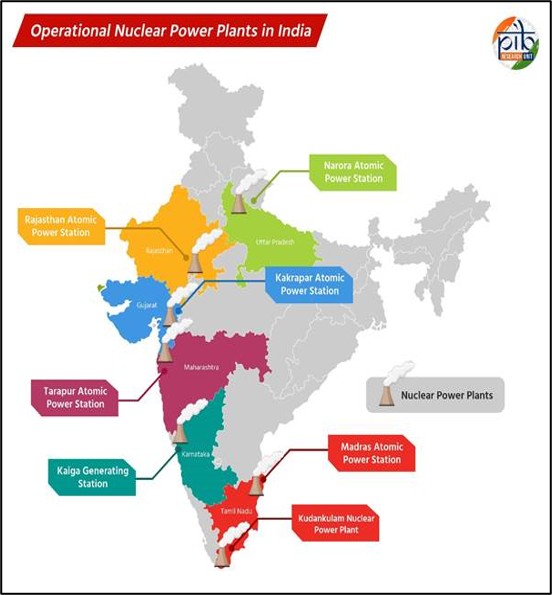
  • India currently operates 24 nuclear power reactors across seven sites with a total installed capacity of 8.78 GW.
  • The reactor fleet comprises:
    • Pressurised Heavy Water Reactors (PHWRs)
    • Boiling Water Reactors (BWRs)
    • Light Water Reactors (LWRs)
  • Most operational PHWRs use natural uranium as fuel while producing plutonium as a by-product.
  • Expansion Plans: 10 reactor units (8,000 MW) are under construction, and pre-project activities have commenced for 10 additional reactors.
  • Nuclear Energy Mission: Announced in the Union Budget 2025–26, it targets 100 GW of nuclear power capacity by 2047and supports Net Zero emissions by 2070.
  • SHANTI Act, 2025: The Sustainable Harnessing and Advancement of Nuclear Energy for Transforming India (SHANTI) Act, 2025 modernises India's nuclear legal framework by enabling limited private participation under regulatory oversight.
    • It also opens new avenues for collaboration and investment.
  • Small Modular Reactors (SMRs): The Union Budget 2025–26 allocated 20,000 crore for indigenous SMRs (up to 300 MWe).
    • Their advantages include factory-based manufacturing, faster construction, improved quality control and phased deployment, with a target of at least five operational SMRs by 2033.
  • Prototype Fast Breeder Reactor (PFBR): India's 500 MWe PFBR at Kalpakkam, developed by BHAVINI, attained first criticality on 6 April 2026, marking the second stage of India's Three-Stage Nuclear Power Programme.
    • It uses plutonium from spent PHWR fuel to breed more fuel and will eventually produce Uranium-233 from thorium, strengthening long-term fuel security and supporting Net Zero.

India’s Three-Stage Nuclear Programme

  • Formulated by Dr. Homi J. Bhabha during the 1950s.
  • Designed to utilise India's limited uranium resources while harnessing its vast thorium reserves for long-term energy security and self-reliance.
  • India possesses around 2% of the world's uranium reserves but nearly 25% of global thorium reserves, primarily located in Kerala, Tamil Nadu, Andhra Pradesh and Odisha.
  • Stage I; Pressurised Heavy Water Reactors (PHWRs): Use natural uranium as fuel and heavy water (D₂O) as both moderator and coolant.
    • It generates electricity while producing Plutonium-239 from Uranium-238, and was chosen because it does not require uranium enrichment.
  • Stage II; Fast Breeder Reactors (FBRs): Uses Mixed Oxide (MOX) fuel prepared from Plutonium-239 recovered from spent PHWR fuel and natural uranium.
    • It produces more nuclear fuel than it consumes by converting Uranium-238 into Plutonium-239, while thorium can be used to produce Uranium-233; the Prototype Fast Breeder Reactor (PFBR) at Kalpakkammarks India's entry into this stage.
  • Stage III; Thorium-Based Reactors: Envisages thorium-fuelled breeder reactorsthat initially use a mixture of Uranium-233 and thorium.
    • Thorium is progressively converted into Uranium-233, enabling large-scale use of India's abundant thorium reserves and ensuring long-term energy independence.

Khan Global Studies App

The most trusted learning platform on your phone

With our training programs, learning online can be a very exciting experience. Take the next step toward achieving your professional and personal objectives.


Download on the App StoreGet it on Google Play
Khan Global Studies mobile app screens
logo
Khan Global Studies Pvt. Ltd. 5th Floor,
A13A, Graphix 1 Tower B, Sector 62,
Noida, Uttar Pradesh 201309

Course Related Query:

Ask Your DoubtsStore Related Query:[email protected]

Get Free Academic Counseling & Course Details

KGS best learning platform

About Khan Global Studies

We love learning. Through our innovative solutions, we encourage ourselves, our teams, and our Students to grow. We welcome and look for diverse perspectives and opinions because they enhance our decisions. We strive to understand the big picture and how we contribute to the company’s objectives. We approach challenges with optimism and harness the power of teamwork to accomplish our goals. These aren’t just pretty words to post on the office wall. This is who we are. It’s how we work. And it’s how we approach every interaction with each other and our Students.


What Makes Us Different

Come with an open mind, hungry to learn, and you’ll experience unmatched personal and professional growth, a world of different backgrounds and perspectives, and the freedom to be you—every day. We strive to build and sustain diverse teams and foster a culture of belonging. Creating an inclusive environment where every students feels welcome, appreciated, and heard gives us something to feel (really) good about.


©Copyright 2026 KhanGlobalStudies

India–Australia Civil Nuclear Cooperation | Current Affairs