KGS

All Exams

Explore All Exams at KGS

All Exams
Current Affairs made simple.

Current Affairs provides you with the best compilation of the Daily Current Affairs taking place across the globe: National, International, Sports, Science and Technology, Banking, Economy, Agreement, Appointments, Ranks, and Report and General Studies

Current Affairs

India Ranks First in Global Coconut Production

SYLLABUS

GS-3: Major crops cropping patterns in various parts of the country, transport and marketing of agricultural produce and issues and related constraints; e-technology in the aid of farmers.

Context: India ranks first globally in coconut production and third in cultivation area, with the sector increasingly shifting from traditional cultivation towards value addition, exports, productivity enhancement and diversified rural livelihoods.

India’s Coconut Sector
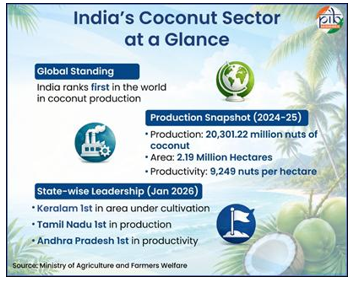
  • India accounts for 24% of global coconut production and 17.90% of global coconut area.
  • During 2024-25, India produced 20,301.22 million nuts from 19 million hectares, with average productivity of 9,249 nuts per hectare.
  • Kerala has the largest area under coconut cultivation at around 54 lakh hectares, while Tamil Nadu leads in production.
  • Andhra Pradesh records the highest productivity, followed by West Bengal and Tamil Nadu.
  • The sector supports nearly 30 million people, including around 10 million farmers, and remains important for rural livelihoods.
  • India’s coconut export basket has diversified from traditional products to virgin coconut oil, coconut milk, coconut water, activated carbon, fresh/frozen/grated coconut, copra and desiccated coconut.
  • Coconut product exports reached ₹7,038.35 crore (USD 794.70 million) in 2025-26, a 62% increase over ₹4,349.03 crore in 2024-25.
  • Major export markets include the USA, UAE, Sri Lanka, Germany, Russia, Türkiye, Belgium, UK and Netherlands.

Government Initiatives for the Coconut Sector
  • Expansion of Coconut Cultivation: Financial assistance of ₹56,000 per hectare is provided for planting coconut seedlings in new areas.
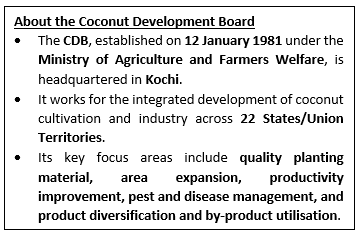
  • Production of Quality Planting Material: The Coconut Development Board supports Demonstration cum Seed Production Farms, seed gardens and nurseries.
  • Productivity Improvement: Under the Productivity Improvement through Coconut-based Cropping System (PICCS), assistance of ₹42,000 per hectare is provided for integrated coconut-based farming. In 2025-26, the programme covered 18,800 hectares, benefiting 48,696 farmers.
  • Coconut Promotion Scheme: Announced in Union Budget 2026-27, it focuses on quality seedlings, expansion into potential areas, replanting and rejuvenation, crop-health management and integrated processing units.
  • It forms part of the ₹350-crore allocation for high-value agriculture, including coconut, cashew and cocoa.
  • MSP Support: Copra is among the 22 mandated agricultural crops covered under the Minimum Support Price regime.
  • NAFED and NCCF are the Central Nodal Agencies for procurement.
  • Value Addition and Export Promotion: The government supports processing, quality certification, branding, trade fairs, buyer-seller meets, market intelligence and export promotion to strengthen the coconut value chain.
  • Skill Development and Entrepreneurship: Programmes such as Friends of Coconut Tree (FoCT), Cocomitra, Kera Kaushal Kendra and Neera Tapping and Processing Technician Training promote skilled employment, rural entrepreneurship and coconut-based enterprises.
  • Technology Mission on Coconut (TMOC): Promotes technologies for pest and disease management, processing, product diversification, research and development and value addition.
  • Kera Suraksha Insurance Scheme: Provides accident insurance coverage to coconut climbers, Neera technicians, hybridisation workers and other coconut labourers.

Significance of the Coconut Sector

  • Livelihood and income diversification: The sector supports nearly 30 million people, including around 10 million farmers, while integrated and multi-tier farming systems provide additional income opportunities.
  • Value addition and exports: Processing coconut into oil, milk, water, activated carbon and other value-added products strengthens rural enterprises and India’s position in global agricultural value chains.
  • Employment and rural development: Coconut-based activities such as processing, handicrafts, Neera tapping, palm climbing and primary processing create employment and entrepreneurship opportunities beyond cultivation.
  • Cultural and economic importance: Revered as the “Kalpavriksha” or Tree of Life, coconut has been part of India’s food, medicine, fibre, timber, fuel and cultural traditions for nearly three millennia.

Khan Global Studies App

The most trusted learning platform on your phone

With our training programs, learning online can be a very exciting experience. Take the next step toward achieving your professional and personal objectives.


Download on the App StoreGet it on Google Play
KGS learning dashboard and mobile application
logo
Khan Global Studies Pvt. Ltd. 5th Floor,
A13A, Graphix 1 Tower B, Sector 62,
Noida, Uttar Pradesh 201309

Course Related Query:

Ask Your DoubtsStore Related Query:[email protected]

Get Free Academic Counseling & Course Details

KGS best learning platform

About Khan Global Studies

We love learning. Through our innovative solutions, we encourage ourselves, our teams, and our Students to grow. We welcome and look for diverse perspectives and opinions because they enhance our decisions. We strive to understand the big picture and how we contribute to the company’s objectives. We approach challenges with optimism and harness the power of teamwork to accomplish our goals. These aren’t just pretty words to post on the office wall. This is who we are. It’s how we work. And it’s how we approach every interaction with each other and our Students.


What Makes Us Different

Come with an open mind, hungry to learn, and you’ll experience unmatched personal and professional growth, a world of different backgrounds and perspectives, and the freedom to be you—every day. We strive to build and sustain diverse teams and foster a culture of belonging. Creating an inclusive environment where every students feels welcome, appreciated, and heard gives us something to feel (really) good about.


©Copyright 2026 KhanGlobalStudies