Explore All Exams at KGS


All Exams
Explore All Exams at KGS

Khan Sir Courses
Geography I Polity I History | World Map I Indian Map I Economics I Biology

UPSC & State PSC
UPSC I BPSC I UP-PSC I MP-PSC

State Exams
UP I Bihar I MP | Rajasthan

NEET | JEE | CUET
NEET | JEE | CUET

Defence Exams
NDA I CDS I CAPF I AFCAT I SSB I Agniveer

Police Exams
UP SI | Bihar SI | Delhi Police | UP Constable

SSC Exams
CGL I CPO I CHSL I MTS I SSC GD I Delhi Police

Foundation Courses
Physics I Chemistry I Biology I History I Geography I Polity I NCERT I Math I English | Map I Reasoning

Railway Exams
RRB | RPF

Teaching Exams
TET | Teaching | UGC

Banking Exams
SBI | RBI | IBPS

Engineering Exams
Civil | Electrical | Mechanical
UGC NET
UGC NET/JRF
Current Affairs provides you with the best compilation of the Daily Current Affairs taking place across the globe: National, International, Sports, Science and Technology, Banking, Economy, Agreement, Appointments, Ranks, and Report and General Studies
Current Affairs
SYLLABUS
GS-2: Bilateral, Regional and Global Groupings and Agreements involving India and/or affecting India’s interests; Important International Institutions, agencies and fora - their Structure, Mandate.
Context: During India's Eighth Trade Policy Review (TPR) at the World Trade Organization (WTO), India reiterated its opposition to incorporating plurilateral agreements into the WTO framework without consensus, leading to differences with several members over the future direction of WTO reforms.
Key Highlights of the Issue
• Concerns Raised by WTO Members
• India's Position
Understanding Plurilateral Agreements
• Meaning: Plurilateral agreements are negotiated among a group of willing WTO members, with the resulting rights and obligations generally applying only to participating members.
• Joint Statement Initiatives (JSIs): Many recent plurilateral negotiations are conducted through JSIs, under which like-minded WTO members negotiate agreements outside the traditional multilateral negotiating framework.
• Legal Status in the WTO: Unlike multilateral agreements, plurilateral agreements are not binding on all WTO members. Only those accepted by consensus can be incorporated into Annex 4 of the Marrakesh Agreement, thereby becoming part of the WTO legal framework.
• Types:
• Objective: They enable willing members to advance negotiations in areas where consensus among all WTO members is difficult to achieve.
• Examples:
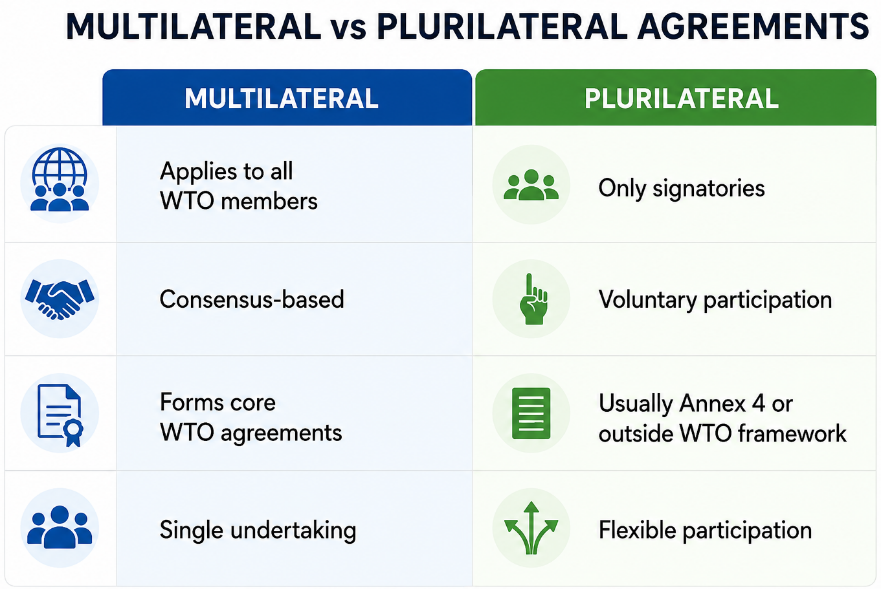
Why are Plurilateral Agreements Becoming Important?
• Breaking Negotiation Deadlocks: They enable willing members to make progress when multilateral negotiations remain stalled under the WTO's consensus-based decision-making process.
• Addressing Emerging Trade Issues: They facilitate rule-making in areas such as digital trade, investment facilitation, environmental sustainability and services that are inadequately covered under existing WTO agreements.
• Flexible Participation: Countries can voluntarily participate based on their interests and level of preparedness without requiring the involvement of all WTO members.
• Modernising the Global Trading System: They help update global trade rules in response to technological advancements and evolving business models.
• Building Wider Consensus: Successful plurilateral initiatives may eventually serve as building blocks for broader multilateral agreements.
India's Concerns over Plurilateral Agreements
• Dilution of Multilateralism: India argues that plurilateral agreements weaken the WTO's consensus-based decision-making and the principle of equal participation by all members.
• Weakening the Development Dimension: Limited participation may marginalise developing and least-developed countries and dilute the principle of Special and Differential Treatment (S&DT).
• Procedural and Legal Concerns: India maintains that plurilateral agreements should not be incorporated into the WTO legal framework without consensus, as required under the Marrakesh Agreement.
• Expansion of WTO's Negotiating Mandate: India contends that issues such as investment facilitation and electronic commerce have not been multilaterally agreed upon for negotiations by all WTO members.
• Fragmentation of Multilateral Trading System: India argues that the proliferation of plurilateral agreements could create multiple layers of trade obligations among WTO members, leading to fragmented trade rules, overlapping commitments and weakening the principle of a uniform, rules-based multilateral trading system.
Khan Global Studies App
With our training programs, learning online can be a very exciting experience. Take the next step toward achieving your professional and personal objectives.



Course Related Query:
Ask Your DoubtsStore Related Query:[email protected]NEET | JEE | CUET
NCERT Books
Resources
We love learning. Through our innovative solutions, we encourage ourselves, our teams, and our Students to grow. We welcome and look for diverse perspectives and opinions because they enhance our decisions. We strive to understand the big picture and how we contribute to the company’s objectives. We approach challenges with optimism and harness the power of teamwork to accomplish our goals. These aren’t just pretty words to post on the office wall. This is who we are. It’s how we work. And it’s how we approach every interaction with each other and our Students.
Come with an open mind, hungry to learn, and you’ll experience unmatched personal and professional growth, a world of different backgrounds and perspectives, and the freedom to be you—every day. We strive to build and sustain diverse teams and foster a culture of belonging. Creating an inclusive environment where every students feels welcome, appreciated, and heard gives us something to feel (really) good about.