Explore All Exams at KGS


All Exams
Explore All Exams at KGS

Khan Sir Courses
Geography I Polity I History | World Map I Indian Map I Economics I Biology

UPSC & State PSC
UPSC I BPSC I UP-PSC I MP-PSC

State Exams
UP I Bihar I MP | Rajasthan

NEET | JEE | CUET
NEET | JEE | CUET

Defence Exams
NDA I CDS I CAPF I AFCAT I SSB I Agniveer

Police Exams
UP SI | Bihar SI | Delhi Police | UP Constable

SSC Exams
CGL I CPO I CHSL I MTS I SSC GD I Delhi Police

Foundation Courses
Physics I Chemistry I Biology I History I Geography I Polity I NCERT I Math I English | Map I Reasoning

Railway Exams
RRB | RPF

Teaching Exams
TET | Teaching | UGC

Banking Exams
SBI | RBI | IBPS

Engineering Exams
Civil | Electrical | Mechanical
UGC NET
UGC NET/JRF
Current Affairs provides you with the best compilation of the Daily Current Affairs taking place across the globe: National, International, Sports, Science and Technology, Banking, Economy, Agreement, Appointments, Ranks, and Report and General Studies
Current Affairs
Context: Launched in 2014 as the National Mission for Financial Inclusion, PMJDY has completed 12 years of expanding formal banking access to previously underserved sections of society.
Understanding PM Jan Dhan Yojana
• PMJDY is India's National Mission for Financial Inclusion, launched on 28 August 2014 to provide affordable access to banking, savings, remittances, credit, insurance and pension services.
• It enables an unbanked person to open a Basic Savings Bank Deposit (BSBD) account through a bank branch or Business Correspondent (Bank Mitra), without any minimum-balance requirement or maintenance charges.
• Its core approach can be captured as “Banking the Unbanked, Securing the Unsecured and Funding the Unfunded”, combining basic accounts with RuPay cards, insurance, overdraft and access to other financial services.
• Key benefits: RuPay debit card with ₹2 lakh accident insurance cover for accounts opened after 28 August 2018; overdraft facility of up to ₹10,000 for eligible account holders; and access to DBT, PMJJBY, PMSBY, APY and MUDRA.
• Evolution of the scheme: Since 2018, the focus has shifted from “every household” to “every unbanked adult”, reflecting a move from household-level access towards individual financial inclusion.
Twelve Years of PMJDY: Key Achievements
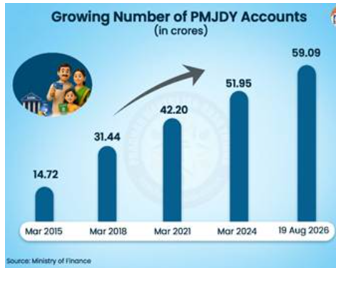
• Massive expansion of banking access: PMJDY accounts increased from 14.72 crore in 2015 to 59.09 crore as of 19 August 2026, nearly a four-fold increase.
• Growing savings and deposits: Total deposits rose from ₹15,670 crore in March 2015 to ₹3,16,514 crore, while the average deposit per account reached ₹5,356, indicating growing participation in formal savings.
• Deep rural and women's reach: 45.95 crore accounts (77.8%) are in rural and semi-urban areas, while 32.92 crore accounts (55.7%) are held by women.
• Expansion of digital financial access: 41.29 crore RuPay debit cards have been issued, providing access to formal payment infrastructure and associated accident insurance.
• Wider financial-inclusion ecosystem: PMJDY has become a foundation for DBT, insurance, pension, credit and digital payments, connecting basic bank-account access with broader financial security and welfare delivery.
Significance/Impact of PMJDY
• Universalising formal finance: PMJDY has substantially reduced the basic access barrier that kept large sections of the population outside the formal banking system, particularly in rural and underserved areas.
• Transforming welfare delivery: As the banking pillar of the JAM architecture, PMJDY enables direct transfer of government benefits into beneficiaries' accounts, reducing dependence on intermediaries and delays.
• Building financial security: By linking account holders with savings, insurance, pension and credit, PMJDY has expanded the role of a bank account from a transaction facility to an entry point into a wider financial-security ecosystem.
• Advancing women's financial inclusion: With women holding 55.7% of accounts, PMJDY has significantly expanded women's formal financial identity and access to welfare and financial services, although account ownership alone does not necessarily imply substantive financial empowerment.
• Creating the foundation for digital financial inclusion: PMJDY's integration with Aadhaar, mobile connectivity and digital payments has helped establish the financial-access layer of India's broader digital financial ecosystem.
Persistent Gaps and Challenges
• Access versus active usage: A bank account does not automatically translate into regular financial participation; inactive/dormant accounts and low transaction activity remain concerns identified in assessments of PMJDY.
• Limited depth of inclusion: The next challenge is ensuring that account holders also gain meaningful access to affordable credit, savings, insurance and pension products, rather than using accounts primarily for receiving transfers.
• Last-mile and digital barriers: Connectivity gaps, limited banking infrastructure and the quality/viability of Business Correspondent networks can constrain reliable access, particularly in remote areas.
• Financial literacy and consumer protection: Limited financial/digital literacy can restrict effective use of financial services, while growing digital adoption creates risks of fraud, mis-selling and financial exploitation.
• Measuring outcomes, not just outreach: The success of financial inclusion increasingly needs to be assessed through usage, quality, financial resilience and economic empowerment, rather than account numbers alone. India's overall Financial Inclusion Index rising from 53.9 in 2018 to 67 in 2026 points towards this broader measurement approach.
Way Forward
• Shift from account opening to active usage: Focus on activating inactive accounts and promoting regular savings, payments and other meaningful financial transactions.
• Deepen access to financial products: Strengthen linkages with affordable credit, insurance, pension and livelihood-oriented financial services, while avoiding over-indebtedness.
• Strengthen last-mile delivery: Improve the viability of Bank Mitras/BCs, banking infrastructure and digital connectivity to ensure reliable financial access in underserved areas.
• Promote safe and informed participation: Expand financial and digital literacy alongside stronger consumer protection, grievance redressal and safeguards against cyber fraud.
• Move towards outcome-based financial inclusion: Evaluate progress through Access, Usage and Quality, with greater emphasis on financial resilience and women's effective use and control of financial resources rather than merely the number of accounts.
Khan Global Studies App
With our training programs, learning online can be a very exciting experience. Take the next step toward achieving your professional and personal objectives.



Course Related Query:
Ask Your DoubtsStore Related Query:[email protected]NEET | JEE | CUET
NCERT Books
Resources
We love learning. Through our innovative solutions, we encourage ourselves, our teams, and our Students to grow. We welcome and look for diverse perspectives and opinions because they enhance our decisions. We strive to understand the big picture and how we contribute to the company’s objectives. We approach challenges with optimism and harness the power of teamwork to accomplish our goals. These aren’t just pretty words to post on the office wall. This is who we are. It’s how we work. And it’s how we approach every interaction with each other and our Students.
Come with an open mind, hungry to learn, and you’ll experience unmatched personal and professional growth, a world of different backgrounds and perspectives, and the freedom to be you—every day. We strive to build and sustain diverse teams and foster a culture of belonging. Creating an inclusive environment where every students feels welcome, appreciated, and heard gives us something to feel (really) good about.